

Zurich-based LatticeFlow AI announced the acquisition of Dublin’s AI Sonar at the World Economic Forum in Davos on January 21, 2026, marking a strategic shift in the European deep tech landscape. The $17.8 million ETH Zurich spinout is now executing M&A strategy, positioning itself as the industry’s first end-to-end evidence-based AI governance platform. In an exclusive interview, CEO Dr. Petar Tsankov explains how Switzerland’s ecosystem enabled building a company in a market that didn’t exist five years ago.
The Acquisition at a Glance
| Acquirer | LatticeFlow AI (Zurich), $17.8M raised since 2021, ETH Zurich spinout |
| Target | AI Sonar (Dublin, CloudSphere subsidiary) |
| Strategic value | Combines AI discovery platform with governance evaluation for end-to-end solution |
| Geographic expansion | Dublin becomes third R&D office alongside Zurich and Sofia |
| Leadership addition | Paul Mansfield (CloudSphere former CTO) joins to lead combined engineering |
| Market positioning | Industry’s first evidence-based, end-to-end AI governance solution |
Building Infrastructure for a Market That Didn’t Exist
Five years ago, AI governance wasn’t a market category. Organizations debated AI ethics principles, but technical infrastructure to operationalize governance didn’t exist. LatticeFlow emerged from this void, grounded in research collaboration with ETH Zurich and INSAIT (Institute for Computer Science, Artificial Intelligence and Technology).
Switzerland’s ecosystem gave us the right conditions to build for what was coming. First, Switzerland has a deep tradition of science-led entrepreneurship. Thanks to our close collaboration with world-class research institutions, such as ETH Zürich, we could ground our work in rigorous, state-of-the-art research.
– Dr. Petar Tsankov, CEO and Co-Founder, LatticeFlow AI
The company’s technical foundation includes COMPL-AI, the world’s first EU AI Act framework for Generative AI, developed in partnership with ETH Zurich and INSAIT. This research-driven approach allowed LatticeFlow to connect AI principles—security, reliability, safety—with verifiable technical controls before the market fully materialized.
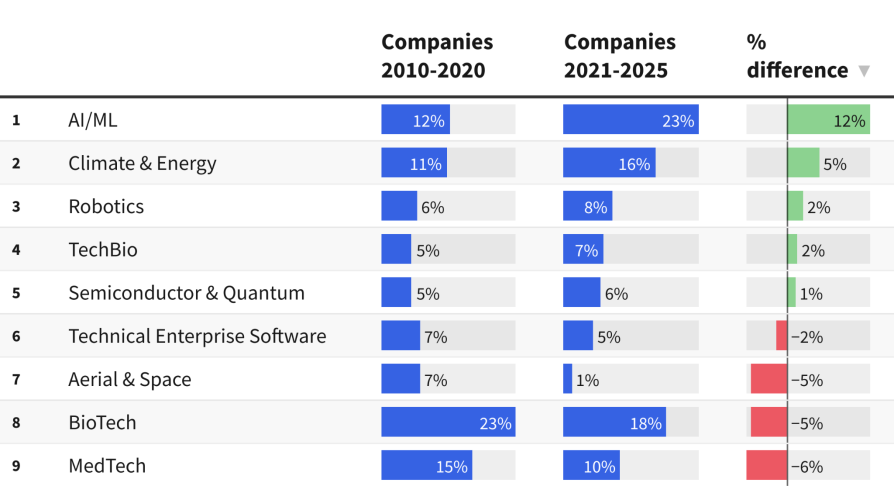
LatticeFlow’s emergence reflects Switzerland’s broader AI sector strength. According to the Swiss Deep Tech Report 2025, AI and machine learning companies now account for 23 percent of Swiss deep tech startups founded since 2021—nearly double their previous share—while Switzerland maintains the highest density of AI talent in Europe at 4.8 percent of the continent’s core AI researchers. The European Spinouts Report 2025 positions ETH Zurich third and EPFL fourth among European universities for deep tech spinout value creation, immediately behind Oxford and Cambridge.
LatticeFlow’s funding trajectory reflects Switzerland’s public-private capital model: $2.8M seed round in 2021 (b2venture, Global Founders Capital), $12M Series A in 2022 (Atlantic Bridge, OpenOcean), and a CHF 3M Innosuisse grant in October 2024. Recognition followed: TOP 100 Swiss Startup and Venture Leaders Technology awards in 2022.
Switzerland bets on strategic, long-term thinking. Private partnerships, support from both venture capital and public non-dilutive capital, gave us the flexibility to focus on fundamentals.
– Dr. Petar Tsankov, CEO and Co-Founder, LatticeFlow AI
Why the Acquisition Matters: Solving the AI Visibility Crisis
AI adoption is outpacing governance capabilities. Enterprises are scaling from managing dozens of AI systems to thousands as AI embeds across applications through software vendors, employee tools, and autonomous agents. This creates a fundamental visibility problem: organizations cannot govern what they cannot see.
AI governance cannot work without visibility. This acquisition reinforces our leadership in evidence-based AI governance by making clear that AI governance is a technical discipline, much like cybersecurity, and must be embedded directly into the technology stack, not managed through paper checklists or dashboards.
– Dr. Petar Tsankov, CEO and Co-Founder, LatticeFlow AI
AI Sonar’s platform automatically identifies AI assets across on-prem and cloud environments, maintaining a continuously updated enterprise AI catalog. The integration with LatticeFlow’s technical evaluation capabilities creates the industry’s first solution that securely connects on-prem AI discovery with centralized SaaS governance operations.
This architecture addresses material organizational risk. Without continuous visibility, security teams cannot protect sensitive data, compliance officers cannot enforce consistent controls, and legal departments react to issues after deployment rather than governing AI proactively throughout its lifecycle. The acquisition enables live, evidence-based assessments as AI systems evolve.
The “Swiss-Made” Advantage in Trust-Critical Markets
Would LatticeFlow be the same company if founded elsewhere? Dr. Tsankov’s answer is unequivocal.
“Definitely no. We may have pushed to grow faster in the short term, but we wouldn’t have built the same level of technical rigor and credibility. And in AI governance, those are the things that differentiate and allow us to scale globally.”
– Dr. Petar Tsankov, CEO and Co-Founder, LatticeFlow AI
The CEO identifies three Swiss advantages embedded in LatticeFlow’s operations:
- Switzerland’s quality and reliability culture pervades every process. Trust isn’t branding; it’s operational methodology.
- Switzerland’s small market size forces entrepreneurs toward global thinking from inception. Talent, customers, partners, and capital are inherently international.
- Most critical for AI governance: Swiss credibility accelerates customer adoption.
The “Swiss-made” label in AI governance carries specific meaning: engineering discipline, verifiable evidence, and independence. Organizations evaluating AI systems need rigorous, technically grounded assessments they can defend to regulators and stakeholders. Switzerland’s culture of proving things before scaling them aligns precisely with what AI governance requires at enterprise scale.
Switzerland stands for precision, neutrality, and reliability. Those qualities matter deeply when customers are making decisions about AI systems that affect regulation, risk exposure, and public trust. In AI governance, credibility accelerates adoption.
– Dr. Petar Tsankov, CEO and Co-Founder, LatticeFlow AI
Switzerland’s Trust Infrastructure Ambitions

LatticeFlow’s growth occurs within Switzerland’s broader positioning as a trust infrastructure hub. The country hosts Trust Valley, an association focused on establishing Switzerland as a center for trust-critical technologies. The convergence of AI governance, cybersecurity, digital identity, and data sovereignty creates a strategic ecosystem where Swiss advantages in trust-critical sectors become increasingly relevant.
Switzerland’s strengths in these areas are structural: neutrality provides independence, precision culture demands verifiable results, and regulatory expertise enables navigation of complex compliance requirements. World-class research institutions supply technical talent, while established industries such as banking, insurance, pharmaceuticals, represent massive markets transforming into AI-first operations.
Building a global AI governance leader from Switzerland is not only a company ambition. It is also an opportunity for Switzerland to become a global reference point for trustworthy AI.
– Dr. Petar Tsankov, CEO and Co-Founder, LatticeFlow AI
The CEO emphasizes that Switzerland’s traditional industries face an existential requirement: their ability to adopt AI safely and at speed will determine global competitiveness. Banking institutions must deploy AI for risk assessment and fraud detection while maintaining regulatory compliance. Pharmaceutical companies need AI for drug discovery without compromising data security. Insurance firms require AI for underwriting and claims processing under strict oversight.
Their ability to adopt AI safely and at speed will determine their global competitiveness in the years ahead. Our goal is to enable this transition by providing the technical foundations that allow these sectors to deploy AI with confidence.
– Dr. Petar Tsankov, CEO and Co-Founder, LatticeFlow AI
Market timing reinforces Switzerland’s advantage. AI governance is transitioning from voluntary best practice to regulatory requirement. The EU AI Act creates compliance obligations that demand technical evidence, not policy documents. Organizations need platforms that generate auditable proof of AI system trustworthiness—precisely what LatticeFlow provides.
Scaling Through Strategic Acquisition

The acquisition flips a familiar European narrative: LatticeFlow represents a Swiss company executing M&A strategy rather than becoming an acquisition target. This demonstrates ecosystem maturation beyond early-stage success toward companies with acquisition capacity.
The strategic logic combines complementary capabilities. Switzerland contributes research depth, technical rigor, and credibility. Ireland adds software development excellence, execution speed, and connections to global technology markets. Paul Mansfield’s addition as engineering leader ensures integration success. Dr. Tsankov articulates how Switzerland functions within this model.
Switzerland acts as a stability and credibility anchor, with world-class research, strong public-private collaboration, and a culture of precision that is essential when building foundational infrastructure like AI governance.
– Dr. Petar Tsankov, CEO and Co-Founder, LatticeFlow AI
Ireland provides complementary strengths: speed, software engineering capacity, and established relationships with global enterprises. The combination creates what the CEO describes as “rigor plus execution, research depth plus scale.”
Europe doesn’t build champions by concentrating everything in one place. It builds them by connecting ecosystems, pairing deep scientific rigor, strong engineering, and applied innovation across borders.
– Dr. Petar Tsankov, CEO and Co-Founder, LatticeFlow AI
LatticeFlow’s vision extends beyond current capabilities. The company aims to build an “AI Control Tower” for enterprises—unified visibility across entire AI portfolios. As AI democratizes from specialists to everyday users deploying autonomous agents, governance must become continuous and embedded, mirroring cybersecurity’s evolution from periodic audits to real-time monitoring.
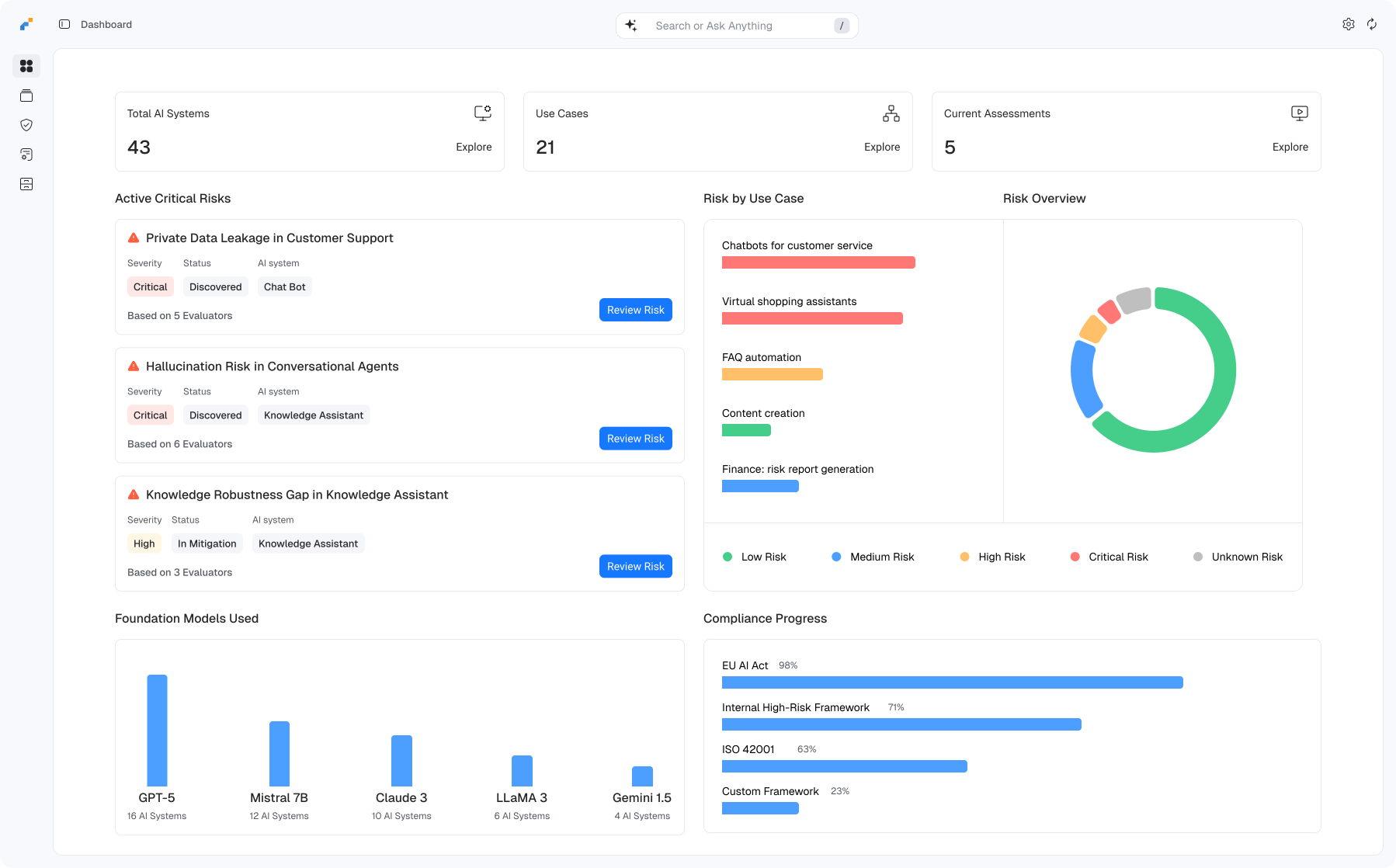
The company commits to anchoring R&D in Switzerland while scaling operations globally. Dublin becomes the third research office, complementing Zurich headquarters and existing operations in Sofia, Bulgaria. This geographic distribution balances Swiss research excellence with execution capabilities across European time zones and talent markets.
A New Blueprint for Cross-European Growth
LatticeFlow’s trajectory from ETH Zurich research to acquisition-executing company validates Switzerland’s deep tech model. The combination of rigorous academic foundation, patient public-private capital, and global market orientation enables category leadership in emerging fields.
The acquisition carries broader significance for Switzerland’s ecosystem. Swiss companies reaching acquisition capacity demonstrates maturation beyond early-stage excellence. When deep tech startups become buyers rather than perpetual targets, ecosystems transition from talent exporters to value accumulators.
Switzerland’s positioning in trust-critical AI infrastructure gains substance through companies like LatticeFlow. AI governance represents a strategic pillar alongside cybersecurity, digital identity, and data sovereignty. As these sectors converge, Switzerland’s precision culture and credibility provide differentiation that capital alone cannot replicate.
The company’s commitment to Swiss-based R&D while executing international M&A offers a template: leverage Switzerland’s research and trust advantages while accessing global talent and markets through strategic expansion. As AI governance matures from emerging category to regulatory requirement, Switzerland’s role as architect of trustworthy AI infrastructure becomes increasingly valuable.
Want to deep dive into one of Latticeflow AI’s early backer? Learn all about b2venture and Andreas Goeldi, Partner, in our October 2025 feature of the VC.

FAQ on LatticeFlow AI and AI Governance
What is AI discovery and why does it matter for governance?
AI discovery is the automated identification of AI systems across an organization’s on-prem and cloud environments. It matters because enterprises are rapidly scaling from managing dozens to thousands of AI deployments. Without continuous visibility into where AI systems exist and how they operate, organizations cannot enforce consistent governance, manage security risks, or demonstrate compliance. AI discovery establishes the foundational inventory that makes governance possible at scale.
How much funding has LatticeFlow AI raised?
LatticeFlow has raised $17.8M since inception in 2021. This includes a $2.8M seed round led by b2venture and Global Founders Capital (2021), a $12M Series A led by Atlantic Bridge and OpenOcean with six investors total (2022), and a CHF 3M grant from Innosuisse (October 2024). The funding reflects Switzerland’s public-private capital model that enables patient, research-driven development.
What makes LatticeFlow’s approach “evidence-based”?
Evidence-based AI governance means providing verifiable technical proof rather than relying on policy documents or checklists. LatticeFlow conducts deep technical assessments of AI systems, generating quantitative evidence on security, reliability, and safety. This approach mirrors how cybersecurity operates: governance embedded in technology infrastructure with auditable results. Organizations can demonstrate compliance through reproducible evaluations rather than process documentation alone.
What role did ETH Zurich play in LatticeFlow’s development?
ETH Zurich provided the research foundation for LatticeFlow’s technology, enabling rigorous, state-of-the-art AI research. The collaboration produced COMPL-AI, the world’s first EU AI Act framework for Generative AI, developed with ETH Zurich and INSAIT. This university partnership allowed LatticeFlow to ground commercial products in cutting-edge research, establishing technical credibility essential for trust-critical markets. ETH Zurich’s spinout ecosystem and research depth exemplify Switzerland’s science-led entrepreneurship tradition.
What is the “AI Control Tower” vision?
The AI Control Tower represents LatticeFlow’s long-term vision: a unified platform providing enterprises with comprehensive visibility across their entire AI portfolio. As AI adoption accelerates and deployment democratizes to everyday users, organizations will manage hundreds of thousands of AI systems rather than a handful controlled by data science teams. The Control Tower would enable continuous, automated governance embedded in the AI technology stack, similar to how security operations centers monitor cybersecurity in real-time.
Would LatticeFlow be the same company if not based in Switzerland?
According to CEO Dr. Petar Tsankov: “Definitely no. We may have pushed to grow faster in the short term, but we wouldn’t have built the same level of technical rigor and credibility. And in AI governance, those are the things that differentiate and allow us to scale globally.” Switzerland’s depth-over-speed culture, research excellence, public-private capital flexibility, and “Swiss-made” credibility in trust-critical markets fundamentally shaped the company’s approach and competitive positioning.
More Content
-
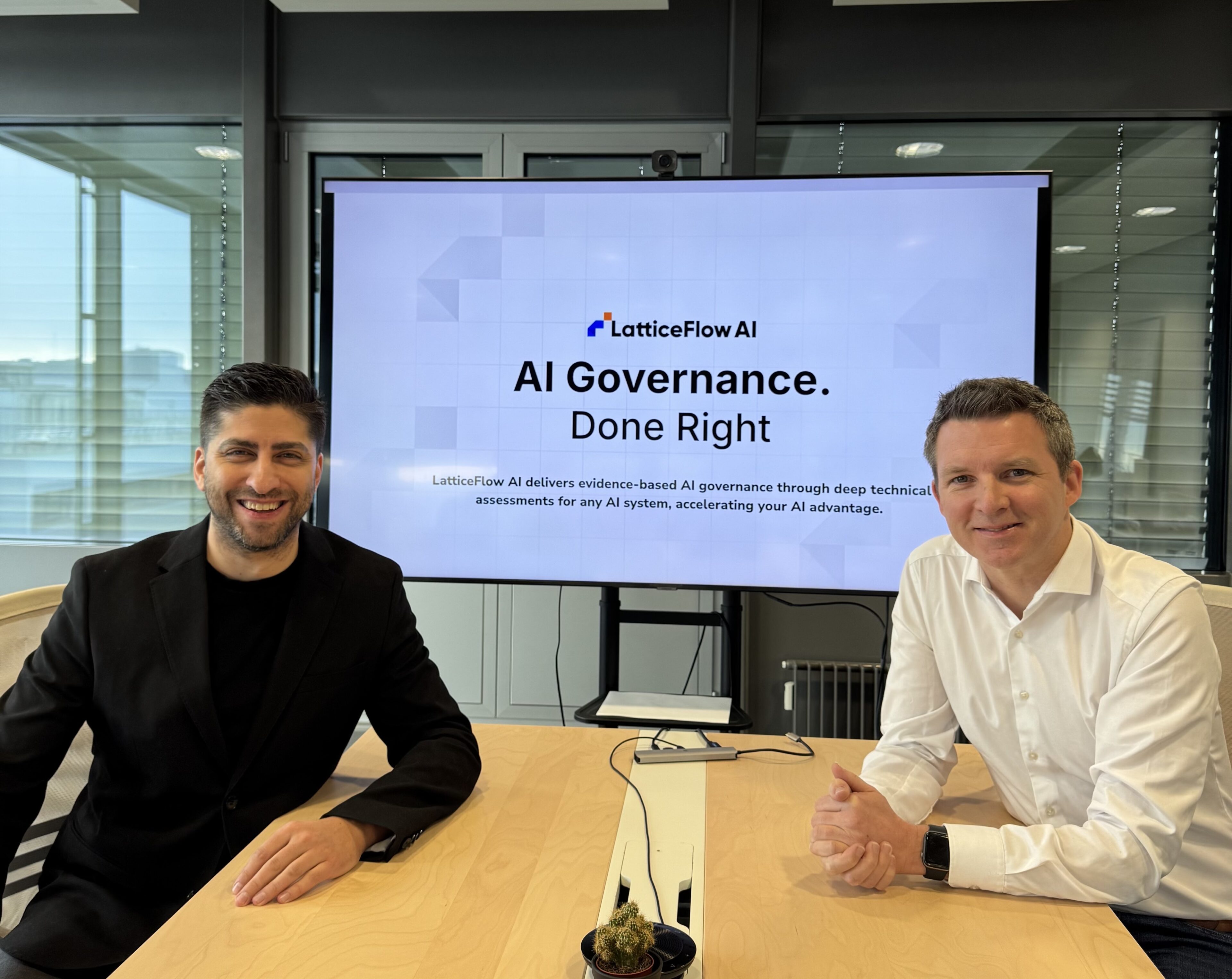
Zurich-based LatticeFlow AI announced the acquisition of Dublin’s AI Sonar at the World Economic Forum in Davos on January 21, 2026, marking a strategic shift…
-
Today marks a defining moment for the Swiss innovation ecosystem. Deep Tech Nation Switzerland officially launching Project Switzerland, a national initiative with a singular, critical…
-

More money has flowed into all Swiss scale-ups per capita than into scale-ups in the US or Israel. This is backed by a ten-year growth…


