Focus Sectors | Verticals
Aerial & Space
The Aerial & Space sector is undergoing a profound transformation, driven by innovations in drones, autonomous UAVs, sustainable aviation, and next-generation space technologies. From enabling safer industrial inspections (e.g., Flyability) to building new infrastructure in orbit (e.g., Swissto12), this vertical is critical for data, logistics, and sustainability, representing a new frontier for high-growth ventures.
Switzerland, a nation renowned for precision engineering, has become a “critical launchpad” for the next generation of aerial and space technologies. The ecosystem’s strength lies in its “unique blend of talent and infrastructure”, which includes world-class academic hubs at ETH Zurich and EPFL and deep collaboration with organizations like the European Space Agency (ESA). This agile and collaborative environment propels technologies from the lab to commercial application at an accelerated pace.
This page provides an investor’s guide to the Swiss Aerial & Space ecosystem. Explore the key hubs, leading companies, and the rising stars that are defining the future of autonomy in the air and in space.
Notable Companies



Key Stats*
40+
VC-Backed startups
$513M
VC funding since 2019
$2.0B
Combined Enterprise Value
Tob Hubs in Zurich (ETH) and Lausanne (EPFL).
* All data is taken from the Swiss Deep Tech Report 2025.
Companies to watch
Drones for hazardous task.
Answer engine for earth observation data.
Complete drone software ecosystem for public safety.
Hosting platform for space payloads.
Drones for asset inspection in extreme weather conditions.
Drones monitoring for nature restoration at scale.
3rd human tissue organoids made in space.
Space operations for the future of space exploration.
Passive microwave moisture mapping with drones.
«With the launch of the European Space Deep Tech Innovation Centre in Villigen, Switzerland is proving how precision science, agile industry and open collaboration can propel space technologies from lab to orbit. This new hub is more than a facility-it’s a testbed where European autonomy meets global opportunity. At ESA, we see Switzerland’s Deep Tech strengths as a catalyst for advancing Europe’s technological sovereignty, commercial competitiveness and innovation resilience.»

Géraldine Naja
Director of Commercialisation, Industry and Competitiveness
ESA
«From the ground breaking work of Auterion in Switzerland to the ambitious ventures of Isar Aerospace and constellr globally, Lakestar sees a clear trajectory for aerospace ventures in Europe. Switzerland’s unique blend of talent and infrastructure creates a fertile ground for innovation, making it a critical launchpad for the next generation of space and aerial technologies. We’re excited to be part of this journey.»

Oliver Heimes
General Partner
Lakestar
Who’s Who in Aerial & Space
-

be-advanced AG
Bern
We guide entrepreneurs to success! with high end Coaching, Workshops and Business Connections
-
Drone Industry Association Switzerland
Geneva
Switzerland’s leading drone association, recognized as the primary hub connecting industry stakeholders, associations, regulators, and the general public.
-

ESA BIC Switzerland
Zurich
ESA BIC Switzerland, an incubator, supports Swiss start-ups using space technologies. It offers tech & business support, up to EUR 200K non-dilutive funding, a large network.
-

Greater Geneva Bern area (GGBa)
Lausanne
Greater Geneva Bern area (GGBa) is the official investment promotion agency for Western Switzerland.
-

QBIT Capital
Zurich
QBIT Capital is an early-stage venture capital firm with offices in Zurich, Villigen and Los Angeles. We invest exclusively in Switzerland.
-

Trust Valley
Lausanne, Geneva
Trust Valley: Swiss Public-Private Partnership (Lake Geneva) for digital trust & cybersecurity. Unifies 400 orgs, runs programs like “Tech4Trust” & “GovTech Challenge”.


Most Active Swiss VCs in Aerial & Space*
-
Swisscom Ventures
Focus on later stage
ICT

Participated in funding round of >100 mio.

Invested in Unicorn



*List established by startupticker.ch based on number of investments in a given vertical
Data-based insights research

“Drone Valley” and the Depth of the Swiss UAV Ecosystem
The Swiss Deep Tech Report 2025 counts more than 40 VC-backed startups in the aerial and space vertical, which have collectively raised USD 513 million since 2019 and represent a combined enterprise value of USD 2 billion. For a country of 8.7 million people, that concentration reflects a strong per-capita output – consistent with Switzerland’s broader deep tech performance – and spans a notably wide range of sub-sectors rather than clustering around a single application: Flyability has made Switzerland a reference point for industrial inspection drones capable of flying inside structures inaccessible to humans; Wingtra leads in fixed-wing VTOL mapping drones for surveying and geospatial applications; Assaia applies computer vision to optimize aircraft turnaround at major airports, with its ApronAI platform now contracted at more than 1,000 gates worldwide; and Sunflower Labs pioneered autonomous security drone systems and in 2025 received FAA approval for beyond-visual-line-of-sight operations across the United States – one of the first such approvals awarded to a European company. This sub-sector diversity is a direct product of the dual heritage of ETH Zurich and EPFL, which together form the engineering backbone of the cluster and have supplied founders, technology standards, and early-stage IP across all of these applications.
The Swiss drone ecosystem, which industry participants have informally named “Drone Valley,” operates within a regulatory environment shaped by proactive national policy. Switzerland was among the first European countries to integrate drones into civilian airspace at scale, and the Drone Industry Association Switzerland – which consistently places Switzerland in the top ten countries represented in the Global State of Drones report – has provided companies with direct access to regulators to influence framework development. The Swiss digital aviation authority U-Space and the national BVLOS testing corridors give startups a path to operational validation that is faster than the EU average, attracting companies to incorporate and test in Switzerland even when their primary markets lie elsewhere.
Software-Defined Defense and the Auterion Trajectory
The company that most concisely illustrates Switzerland’s capacity to produce globally consequential deep tech ventures is Auterion. Founded in 2017 by Dr. Lorenz Meier, a researcher at ETH Zurich who had previously created the PX4 open-source autopilot standard – now the dominant firmware platform for commercial and defense drones worldwide – Auterion began as the company commercializing PX4 and has since evolved into the operating system for autonomous mass operations. In September 2025, Auterion raised a USD 130 million Series B led by Bessemer Venture Partners, which valued the company at north of USD 600 million, according to Bloomberg. The round included USD 25 million in non-dilutive capital from the U.S. Department of Defense through the Office of Strategic Capital. The company had by that point already secured a USD 50 million Pentagon contract to deliver 33,000 AI-enhanced drone strike kits to Ukrainian forces, described at announcement as the largest deployment of autonomous technology in the West to date.
That growth trajectory also makes Auterion a concrete illustration of the legal constraints that shape how Swiss defense tech companies must structure themselves. Switzerland’s Federal War Material Act prohibits the direct export of military equipment to active belligerents and bars third countries from re-exporting Swiss-made arms that represent more than 50% of a weapon system’s value – a restriction codified in neutrality law enshrined since the 1815 Treaty of Paris. A parliamentary clause that had allowed the Federal Council to grant case-by-case exemptions was scrapped in late 2021, just months before Russia invaded Ukraine, creating a legal environment that proved difficult for companies pursuing contracts with the US Department of Defense or allied governments engaged in active conflicts. Auterion responded structurally: in May 2024 it relocated its corporate headquarters from Zurich to Arlington, Virginia, placing its defense contracting entity under US jurisdiction while retaining engineering operations in Switzerland. The move was driven in part by the need to qualify for Pentagon procurement frameworks – including the Defense Innovation Unit’s Blue UAS architecture – which require US-domiciled entities. Auterion is not unique in this; Bloomberg reported in April 2025 that Switzerland’s defense industry association knew of no Swiss defense firm that had not already moved capacity abroad or developed a contingency plan to do so, with the ASD federation noting that “defense customers only placed new orders with us if we could guarantee that our products were not manufactured in Switzerland.” The Swiss parliament passed a partial reform in December 2025, allowing war material to be sent to a defined group of 25 mostly Western nations even in ongoing conflicts, but the underlying structural constraint – that Swiss-incorporated companies face significant legal exposure when operating in active defense markets – has not been removed and continues to shape where founders and investors choose to domicile defense-facing operations.
Auterion’s trajectory matters beyond the funding figures because it demonstrates a structural dynamic unique to Switzerland’s aerial sector: university-born software standards becoming the backbone of an entire global industry. The PX4 standard, which Meier developed at ETH Zurich, now runs on drones from hundreds of manufacturers across defense, commercial, and civilian markets. Auterion’s AuterionOS platform has built a defense ecosystem around that foundation – with Rheinmetall, Lockheed Martin, and Taiwan’s national defense prime among its partners – while maintaining engineering operations in Zurich. The company’s February 2026 joint venture with Ukrainian defense manufacturer Airlogix, announced at the Munich Security Conference, to manufacture AI-guided drones for Ukraine and NATO allies, further cements Switzerland’s role as a deep tech source layer for European defense capability.
Space Infrastructure and ESA’s Swiss Anchor
Switzerland’s position in the space vertical rests on 2 EPFL spin-offs that are each defining new categories of commercial space activity, and on a structural institutional investment by ESA that signals the country’s growing role in European space sovereignty.
SWISSto12, founded in 2011 out of CEO Emile de Rijk’s PhD research at EPFL, manufactures advanced satellite RF products and systems using patented 3D-printing techniques that make components up to ten times lighter than conventional alternatives – a critical advantage where every kilogram of mass translates directly into launch cost. The company has deliberately avoided the crowded low-Earth orbit market in favor of building a new class of compact, cost-efficient geostationary satellites through its HummingSat platform, developed in partnership with ESA and scheduled for its first commercial launch with SES in 2027. In January 2026, SWISSto12 secured €73 million from ESA member states through the ARTES HummingSat Partnership Project, and a concurrent private round from European investors brought its total fresh funding past €100 million, according to the EU-Startups announcement. ClearSpace, also an EPFL spin-off, holds a €86 million ESA service contract to execute the world’s first active debris removal mission, ClearSpace-1, targeting the PROBA-1 satellite – a mandate that places Switzerland at the center of a commercial market for in-orbit services that ESA estimates will become essential as orbital congestion increases.
The institutional anchor for these activities arrived in May 2025 with the inauguration of the European Space Deep-Tech Innovation Centre (ESDI) at the Switzerland Innovation Park Innovaare in Villigen – ESA’s first physical presence in Switzerland, built in collaboration with the Paul Scherrer Institute. ESDI runs research platforms in quantum, data, and materials science to accelerate the translation of deep tech into space applications. At the opening ceremony, ESA’s Director of Commercialisation Géraldine Naja signed a Memorandum of Understanding with Deep Tech Nation Switzerland Foundation, formally connecting the European space community to Switzerland’s broader deep tech ecosystem. Together with the existing ESA Business Incubation Center at ETH Zurich, which provides up to €200,000 in non-dilutive funding to space-tech startups, Switzerland now hosts a layered institutional infrastructure for space entrepreneurship that few European countries can match.
Success Stories
-
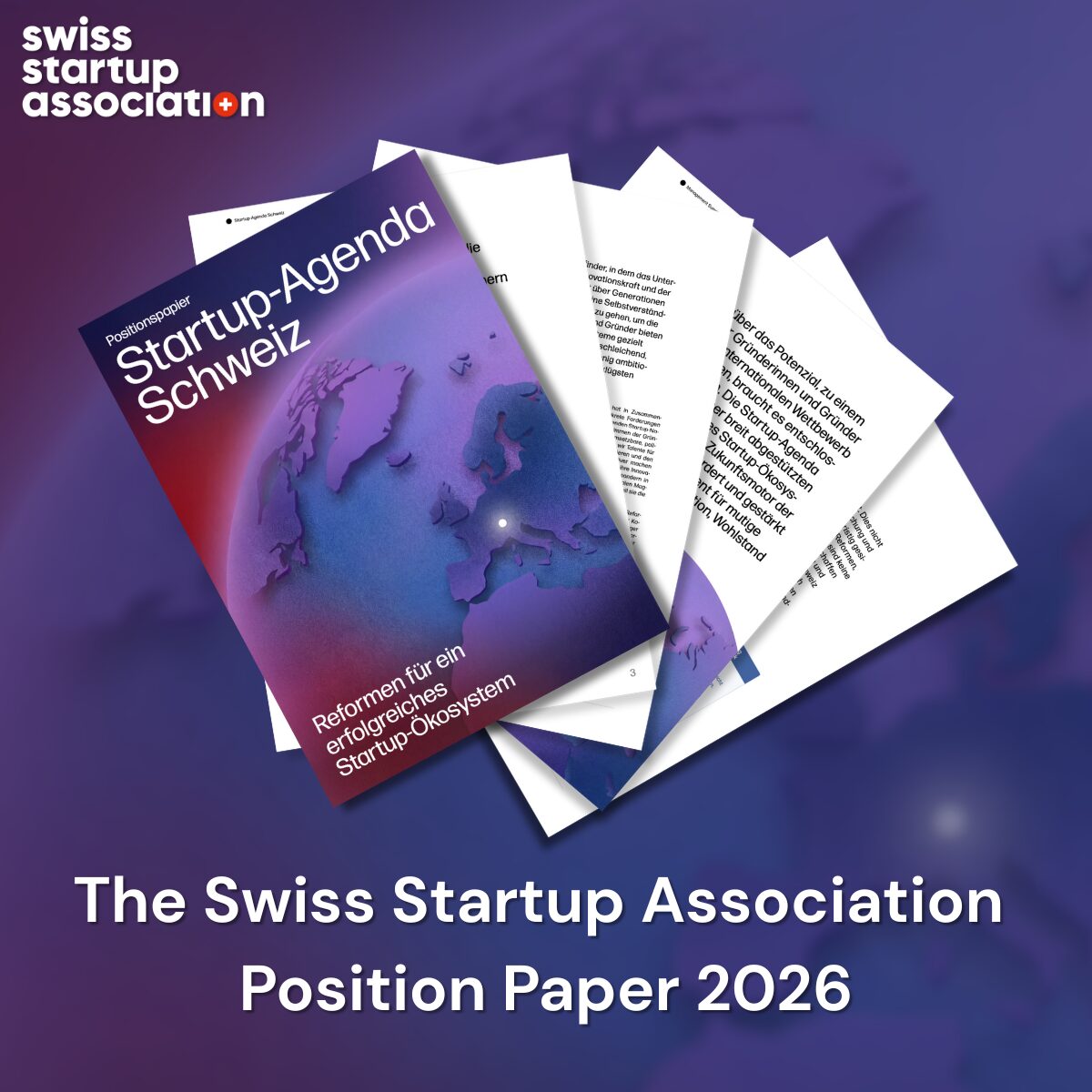 Read more: 20 Reforms to Compete Globally: The Swiss Startup Agenda by SSA
Switzerland’s startup ecosystem has reached a critical inflection point. While the country continues to lead Europe in per-capita spinout creation and deep tech innovation, structural…
-
 Read more: A Surprising Record Sparks Optimism
On 3 February, the Venture Capital Report was published, analysing investments in Swiss start-ups in 2025. Despite growth of 24 per cent, the total capital…
-
Read more: Switzerland: A Leading Global Scale-up Hub
More money has flowed into all Swiss scale-ups per capita than into scale-ups in the US or Israel. This is backed by a ten-year growth…


Aerial & Space
News
-
United Airlines Ventures invests in Assaia
Assaia, a leader in artificial intelligence and computer vision for airport operations, attracted an investment from United Airlines Ventures (UAV), the venture capital arm of…
startupticker.ch
-
CDDS secures seed capital for further development steps
Defense startup CDDS (Counter Defense Drone Systems) has secured Swisscom Ventures as an investor in a seed funding round. With the fresh capital, the startup…
startupticker.ch
-
SWISSto12 raises US$70 Million to meet growing multi-orbit demand
SWISSto12, a leading enabler of the new space economy, today announced the close of its $70 million Series C. The Series C fundraise follows a…
startupticker.ch
-
PAVE Space raises $40M to disrupt satellite deployment
PAVE Space, a Swiss space infrastructure company, today announced it has raised USD 40 million in seed funding to develop a new generation of spacecraft…
startupticker.ch
-
Auterion and Airlogix launch Joint Venture to scale autonomous drone production
Auterion, the global leader in autonomous drone operating systems, and Airlogix, a Ukrainian defense technology company, announced during the Munich Security Conference the formation of…
startupticker.ch
-
Assaia finalises $26.6m Series B round to scale aviation technology
Assaia, the Zurich-based aviation technology company dedicated to optimizing the commercial aircraft turnaround process, has raised $26.6m in an oversubscribed Series B funding round led…
startupticker.ch
FAQ on Aerial & Space
1. What are the key strengths of Switzerland’s Aerial & Space sector?
The sector’s strength is its “unique blend of talent and infrastructure”, combining precision engineering, deep robotics and AI talent from ETH Zurich and EPFL, and a supportive industrial ecosystem.
2. How does the European Space Agency (ESA) collaborate with Switzerland?
Switzerland is a key ESA
member. ESA’s Director of Commercialisation notes that Switzerland’s deep tech strengths are a “catalyst for advancing Europe’s technological sovereignty” and recently launched the European Space Deep Tech Innovation Centre in Villigen, Switzerland. Additionally, ESA has a Business Incubator Center at ETH Zurich.
3. Which are the leading Swiss drone and UAV companies?
The Swiss drone ecosystem (“Drone Valley”) is world-renowned, led by companies like Auterion (drone operating systems), Flyability (indoor inspection drones), and Wingtra (mapping drones).
4. What makes Switzerland a “critical launchpad” for space tech?
According to Lakestar, Switzerland’s “blend of talent and infrastructure creates a fertile ground for innovation”. This is proven by global leaders like Swissto12 (3D-printed satellite components) and ClearSpace (in-orbit debris removal).
5. What investment opportunities are emerging in Swiss sustainable aviation?
Beyond drones, Switzerland is a hub for sustainable aviation. Key companies include H55 (electric propulsion), founded by the pioneers of Solar Impulse, and Metafuels (sustainable aviation fuel).


