Focus Sectors | Verticals
Future of Compute
Semiconductors & Quantum are the “enabling technologies” that power all other deep tech verticals, from artificial intelligence to the energy transition. This sector includes the design and manufacturing of novel semiconductor chips, photonics, and neuromorphic computing, as well as the development of quantum hardware, software, and sensing. These are foundational technologies that unlock exponential leaps in computing power and performance.
Switzerland has emerged as a premier global hub for this “hard tech,” anchored by world-class talent from ETH Zurich, EPFL, and specialized research institutes like CSEM and CERN. For investors, the Swiss ecosystem offers a “uniquely stable environment” insulated from geopolitical volatility, which is critical for the long-term R&D cycles these technologies demand. A new, ambitious generation of founders is tackling the full stack, supported by generous R&D funding and a culture of continuous innovation.
On this page, we detail the companies building the future of computing. Discover the top-funded startups like Kandou, Sensirion, and Terra Quantum, the diverse research hubs, and the “companies to watch” that are positioning Switzerland as a leader in both the semiconductor and quantum revolutions.
Notable Companies

Key Stats*
70+
VC-Backed startups
$532M
VC funding since 2019
$1.7B
Combined Enterprise Value
Tob Hubs in Zurich, Stäfa (ETH), Lausanne (EPFL), Geneva (CERN), Neuchâtel (CSEM), Bern and Basel.
* All data is taken from the Swiss Deep Tech Report 2025.
Companies to watch
Liquid cooling for high-power chips in data centers.
Photonic chip foundry for thin-film Lithium Niobate.
Trapped-ion quantum computers.
Nanotechnology fabrication for electronics.
Next-generation ultrafast lasers for precision sensing.
Photonic chip foundry for thin-film Lithium Niobate.
Photonic hardware solutions for transmitting data.
Single-photon processing for computational imaging.
AI agents accelerating microchip development.
«Switzerland’s strength in Deep Tech, particularly in semiconductors, is built on world-class talent, cutting-edge research, and a culture of continuous innovation. Our collaborative ecosystem turns bold ideas into technologies that shape global industries. At Kandou, we are proud to contribute to this momentum-developing foundational technologies that democratize Al and push the boundaries of what’s possible, making advanced solutions more accessible and impactful worldwide.»

Amin Shokrollahi
Co-Founder & CTO
Kandou Bus
«Switzerland has one of the strongest Deep Tech talent pools in the world, anchored by ETH and EPFL. It attracts top international talent, supported by generous public R&D funding. The country offers a uniquely stable environment to build, insulated from the academic politicization and culture wars seen elsewhere.»

Alexis Houssou
Founder & Managing Partner
HCVC
Who’s Who in Future of Compute
-
AGIRE FOUNDATION
Lugano
We are the Innovation Agency of southern Switzerland and we provide support to start-ups and innovative SMEs on their path to growth.
-

DAA Ventures
Geneva
We are a Venture Capital firm investing in deeptech startups in Switzerland and Europe
-

-

FONGIT
Geneva
We support entrepreneurs with the expertise, resources and financing they need in transforming innovative ideas into sustainable companies.
-

Founderful
Zurich
Founderful is Switzerland’s leading pre-seed fund. First, fast & founder-friendly, backing Switzerland’s best tech entrepreneurs to become global market leaders.
-

Microsoft Switzerland
Zurich
Microsoft Switzerland empowers all customers to realize their full potential. We enable digital transformation via AI, cloud & edge technology, backed by 1k experts & 4.6k partners.
-
QBIT Capital
Zurich
QBIT Capital is an early-stage venture capital firm with offices in Zurich, Villigen and Los Angeles. We invest exclusively in Switzerland.
-
SEF.Growth
Bern
SEF.Growth supports Swiss start-ups & SMEs overcome growth challenges via expert feedback, coaching, & the High Potential Label to accelerate market success/network access.


Most Active Swiss VCs in Future of Compute
-
Founderful
Focus on early stage
Cleantech
-
QBIT capital
Focus on early stage
ICT
-
SICTIC
Focus on early stage
ICT
-
Swisscom Ventures
Focus on later stage
ICT

Participated in funding round of >100 mio.

Invested in Unicorn
-

Verve Ventures
All stages
Medtech

Data-based insights research
A Design-Led Cluster Built on Decades of Applied Research
The Swiss Deep Tech Report 2025 counts 70+ VC-backed startups in the Swiss semiconductors and quantum sector, with USD 532 million raised since 2019 and a combined enterprise value of USD 1.7 billion. The cluster is anchored by three institutions with direct spinoff programs: ETH Zurich and EPFL in chip design, photonics, and quantum hardware, and CSEM in Neuchâtel, which operates as Europe’s leading independent ASIC design and microtechnology center with a track record of industrial spinoffs in low-power electronics, sensor integration, and precision timing. In May 2025, CCRAFT — a direct CSEM spinoff — launched the first production-ready foundry for thin-film lithium niobate photonic chips, a material platform critical to AI-scale optical interconnects and quantum networking infrastructure.
The concentration in chip design rather than fabrication has been reinforced by the SwissChips initiative, launched in February 2024 and running through 2027. The CHF 33.8 million program is jointly funded by the State Secretariat for Education, Research and Innovation (SERI) at CHF 26 million and by ETH Zurich, EPFL, and CSEM contributing CHF 7.8 million combined. Led by Prof. Christoph Studer of ETH Zurich, it covers eight work packages spanning AI-specific chip design, 6G communications, space electronics, photonics, and biomedical chips. The initiative was launched as a direct response to Switzerland’s exclusion from the EU’s Digital Europe programme and its limited access to Horizon Europe, both of which restricted Swiss researchers from strategic calls in semiconductors and microelectronics between 2021 and 2024. Its infrastructure and design resources are open to all Swiss universities and universities of applied sciences.
The Patient-Capital Track Record
Sensirion, an ETH Zurich spinoff founded in 1998, became the world’s largest manufacturer of digital humidity and temperature sensors and listed on the SIX Swiss Exchange in 2018. Kandou Bus, founded in 2011 from EPFL research on high-speed chip-to-chip communication, has grown into a key IP licensor for AI chip interconnects used by major semiconductor OEMs. u-blox — founded in 1997 as an ETH Zurich spinoff, listed in 2007, and serving more than 10,000 customers across automotive, industrial IoT, and precision agriculture — was acquired by US private equity firm Advent International in November 2025 for CHF 1.05 billion, at a 53% premium to the six-month volume-weighted average price before acquisition rumors surfaced, with the company committing to remain headquartered in Thalwil, Zurich. The transaction validates a 28-year trajectory from ETH spinoff to billion-franc exit and is the largest semiconductor exit in Swiss startup history.
Earlier in 2025, Carl Zeiss Microscopy GmbH acquired Lausanne-based Pi Imaging Technologies in July, integrating its photonic imaging chip technology into the Zeiss microscopy portfolio. At the growth stage, Corintis closed a USD 24 million Series A in September 2025 to bring its ETH-developed microfluidic liquid cooling system for high-power AI chips to mass production, targeting the thermal management bottleneck that limits current GPU and accelerator deployments in data centers.
Quantum: From QKD Pioneer to Hardware Stack
ID Quantique, founded in 2001 from the University of Geneva’s Group of Applied Physics, deployed the world’s first commercial quantum cryptography system in 2007 — used to secure cantonal elections in Geneva — and has since become a global supplier of quantum key distribution systems, photon counters, and quantum random number generators. Zurich Instruments, an ETH spinoff founded in 2008, manufactures quantum computing control electronics — the hardware layer between software and physical qubits — and supplies the majority of major quantum hardware research programs worldwide.
Federal investment has since scaled that base. The Swiss Quantum Initiative (CHQI), launched in 2022, secured CHF 80 million in government funding across 2024 to 2028 for research infrastructure, national programs, and international partnerships. At the private infrastructure level, QuantumBasel — backed by approximately USD 500 million from the uptownBasel development — has partnered with IBM, D-Wave, and IonQ. In December 2024, QuantumBasel deployed a fully operational IonQ Forte Enterprise 35-qubit quantum computer on-site in Basel — the first commercially deployed quantum system in Switzerland — alongside a CHF 50 million QAI Ventures fund dedicated to quantum startups. At the company formation layer, ZuriQ — an ETH Zurich spinoff founded in 2024 from the labs of Prof. Jonathan Home — raised a USD 4.2 million seed round in January 2025 led by Founderful to commercialize a two-dimensional trapped-ion architecture designed to overcome the qubit-scaling ceiling of conventional one-dimensional ion chain systems, targeting pharmaceuticals and financial services as primary markets for utility-scale quantum computing.
Success Stories
-
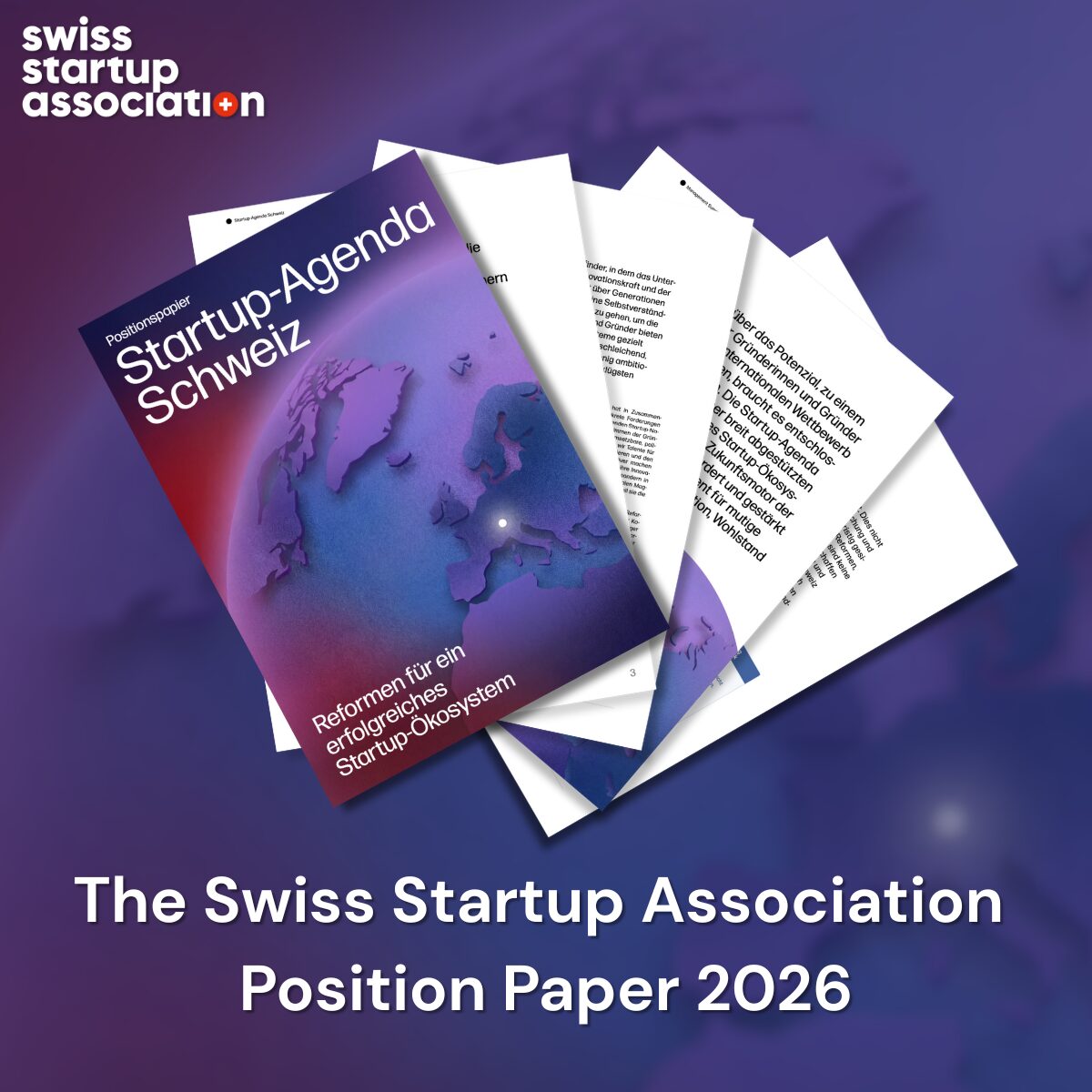 Read more: 20 Reforms to Compete Globally: The Swiss Startup Agenda by SSA
Switzerland’s startup ecosystem has reached a critical inflection point. While the country continues to lead Europe in per-capita spinout creation and deep tech innovation, structural…
-
 Read more: A Surprising Record Sparks Optimism
On 3 February, the Venture Capital Report was published, analysing investments in Swiss start-ups in 2025. Despite growth of 24 per cent, the total capital…
-
Read more: Switzerland: A Leading Global Scale-up Hub
More money has flowed into all Swiss scale-ups per capita than into scale-ups in the US or Israel. This is backed by a ten-year growth…


Future of Compute
News
-
CHF2 million to integrate quantum processors in high-performance computers
Qambria builds the classical engine designed to address the bottlenecks between quantum and classical compute. The company from the Canton of Thurgau has closed a…
startupticker.ch
-
Quantonation leads USD 25.5 million seed round for ETH spin-off ZuriQ
ZuriQ has raised USD 25.5 million in a seed round to scale the trapped-ion quantum processors it is building on a two-dimensional chip architecture. The…
startupticker.ch
-
CCRAFT closes USD 7.8 million funding round to scale up its photonic chips foundry
Photonic chip manufacturer CCRAFT has successfully completed its funding round, securing USD 7.8 million (CHF 6.3 million) with investors from Switzerland and Germany. The proceeds…
startupticker.ch
-
Quantum Design completes acquisition of Qnami
Quantum Design has acquired Qnami, a leading developer of diamond-based quantum sensing technologies with its roots at the Physics Department of the University of Basel.…
startupticker.ch
-
Terra Quantum changes its IPO plans
Following an initial announcement in April regarding an IPO via SPAC, Terra Quantum has now presented a new plan involving a different shell company and…
startupticker.ch
-
USD 3.8 million to bring real-time spatial intelligence to every consumer device
Mosaic SoC is building next-generation perception chips that help devices see and understand their environment in real time at minimal power. In its first year,…
startupticker.ch
FAQ on Future of Compute
1. Why is Switzerland a top location for semiconductor and quantum startups?
Switzerland combines one of the world’s strongest deep tech talent pools from ETH Zurich and EPFL with a “uniquely stable environment” and a new generation of ambitious founders focused on building global leaders.
2. What is the “uniquely stable environment” for R&D in Switzerland?
As noted by HCVC, Switzerland offers a stable environment to build, “insulated from the academic politicization and culture wars seen elsewhere”, which is a major advantage for long-term deep tech R&D.
3. Which research institutions anchor the Swiss quantum and semiconductor ecosystem?
Beyond ETH Zurich and EPFL, key R&D centers include CSEM
(microtechnology), CERN (advanced engineering), and the Paul Scherrer Institut (PSI).
4. Who are the top semiconductor companies to watch in Switzerland?
The next generation includes CORINTIS (liquid cooling for data centers), SynSense (neuromorphic computing), ZuriQ (trapped-ion quantum computers), and LIGHTIUM (photonic chips).
5. What are the key investment trends in Swiss photonics and chip design?
Investors are backing highly technical teams across the full stack, including novel compute architectures, photonics, thermal management, and emerging modalities for quantum computing. Key companies include Kandou (high-speed connectivity) and Sensirion (sensor chips).
6. How does Switzerland’s quantum research compare globally?
Swiss universities and research centers are at the forefront of quantum research, particularly in trapped-ion computing (ZuriQ) and quantum sensing, creating a strong pipeline of venture-backable spin-offs.


