Focus Sectors | Verticals
BioTech
BioTech is the flagship vertical of the Swiss deep tech ecosystem, focused on the discovery and development of novel drugs and therapies to address the world’s most pressing diseases. As a “global hotspot for biotech innovation”, Switzerland has cultivated a complete, mature ecosystem that has generated more venture capital, more startups, and more enterprise value than any other sector.
The nation’s status as a “BioTech powerhouse” is built on two pillars: the “exceptional concentration of pharma expertise around Basel”, home to industry giants like Roche and Novartis, and the world-class academic excellence flowing from its universities. This combination has created a “proven playbook that moves discoveries from lab to high-valued exit”, attracting over 85% of its funding from international investors who recognize the sector’s global appeal and proven track record.
With over 275 active startups and $4.8B in funding since 2019, the Swiss BioTech pipeline is robust and deep. This page provides a comprehensive overview of the investment landscape, the “companies to watch” in this powerhouse sector, and the key hubs that cement Switzerland’s role as a launchpad for world-class biomedical innovation
Notable Companies

Key Stats*
275+
VC-Backed startups
$4.8B
VC funding since 2019
$64B
Combined Enterprise Value
Tob Hubs in Basel (pharma hub), Zurich, Lausanne and Geneva.
* All data is taken from the Swiss Deep Tech Report 2025.
Companies to watch
Precision drugs targeting eukaryotic pathogens.
Antibodies targeting inflammation, autoimmunity, and fibrosis.
Medicines for immunologic & inflammatory diseases.
Treatments for obstructive sleep apnea.
Allosteric modulator therapeutics for underserved neurological disorders.
Therapeutic solutions for male and female infertility.
Gene therapy for retinal diseases causing blindness.
Biotechnological solutions targeting muscle for metabolic health.
Revitalizing cells to address age-related and chronic diseases.
«Switzerland has long been a global hotspot for biotech innovation. The exceptional concentration of pharma expertise around Basel, combined with academic excellence and access to capital, continues to make it one of the world’s most fertile grounds for breakthrough biomedical innovation.»

Severin Schwan
Chairman
Roche
«Switzerland is a powerhouse in European innovation, attracting the highest volume of deep-tech capital per capita. BioTech and Life Science continue to stand out as the country’s flagship verticals, powered by a proven playbook that moves discoveries from lab to high-valued exit. International investors supply over 85 percent of all Swiss investments, rising to 96% in large rounds, underscoring Switzerland’s global appeal. Al and ML are gaining ground fast, yet biotech excellence remains the benchmark, cementing the nation’s role as a launchpad for world-class innovation.»
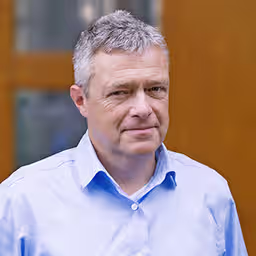
Diego Braguglia
Managing Partner
Vi Partners
Who’s Who in BioTech
-
>>venture>>
Zurich
>>venture>> is Switzlerland’s leading early-stage startup competition. Established in 1997, it is co-organized by ETH Zurich, McKinsey & Company, Knecht Holding, Innosuisse, and EPFL. Every year, the competition supports innovative startups by providing them with over CHF 590,000 in non-dilutive funding, mentorship and access to an vast network of industry experts.
-
AGIRE FOUNDATION
Lugano
We are the Innovation Agency of southern Switzerland and we provide support to start-ups and innovative SMEs on their path to growth.
-
Basel Area
Basel Area
As a non-profit organization, we provide services to companies, institutions and startups interested in exploring business opportunities or innovative projects in the cantons of Basel-Stadt, Basel-Landschaft and Jura.
-
Bio-Technopark Schlieren-Zürich
Zurich
The Bio-Technopark is a life science park housing 60 companies and organizations, as well as 80 academic research groups. The park has offices and laboratories.
-
-
Eawag: Swiss Federal Institute of Aquatic Science and Technology
Duebendorf
Eawag is one of the world’s leading aquatic research institutes.
-
ETH Entrepreneurship
Zurich
ETH Entrepreneurship supports, encourages & challenges entrepreneurs & start-ups. It is the leading organization for the ETH Pioneer Fellowship & UPortunity ETH accelerator.
-
-
Fondation pour l’innovation et la technologie
Lausanne
The Foundation for innovation and technology (FIT) provides grants and loans to support positive innovation; for tech, digital and low-tech projects and early-stage startups in Vaud & Romandie.
-

FONGIT
Geneva
We support entrepreneurs with the expertise, resources and financing they need in transforming innovative ideas into sustainable companies.
-
-
Gebert Rüf Stiftung
Zurich
Foundation’s CHF 15M annual budget helps tech breakthroughs & builds entrepreneurial attitude/innovation interest via education & transfer projects.


Most Active Swiss VCs in BioTech*
-
Ace Ventures
Focus on early stage
Climate and Energy

Invested in Unicorn
-

BioMedPartners
Focus on early stage
Biotech

Participated in funding round of >100 mio.
-
Business Angels Switzerland
Focus on early stage
ICT
-
Forty:one
Focus on early growth
ICT
-
Occident
Focus on early growth
Medtech
Participated in funding round of >100 mio.
-
Pureos bioventures
All stages
Biotech
Participated in funding round of >100 mio.
Invested in Unicorn
-
Redalpine Ventures
All stages
Biotech
Participated in funding round of >100 mio.
Invested in Unicorn
-
SICTIC
Focus on early stage
ICT
-
Swisscanto
Focus on later stage
ICT
Participated in funding round of >100 mio.
Invested in Unicorn
-
Verve Ventures
All stages
Medtech


*List established by startupticker.ch based on number of investments in a given vertical
Data-based insights research
A Science-First Ecosystem
Switzerland’s biotech sector is built on a higher ratio of formal university spin-offs than any comparable ecosystem in Europe. Nearly 200 of the roughly 350 Swiss biotech startups are official spin-offs, according to the Swiss Biotech Report 2025 published by the Swiss Biotech Association and EY. The primary engines are ETH Zurich and EPFL, which together generate 60 to 70 spin-offs per year across all sectors, with biotech consistently the largest category. The European Spinout Report 2025 found that, while the UK, France and Germany lead in absolute value creation from spin-offs, Switzerland is the clear leader in value created per capita – a distinction that reflects the intensity and translational quality of its academic output rather than the size of its market. ETH Zurich spin-offs also report a 5-year survival rate of 93%, compared to 68% for equivalent companies from leading US universities, a gap that institutional investors have increasingly noted when allocating early-stage capital to Swiss biotech.
Araris Biotech, acquired by Taiho Pharmaceutical in 2025 for up to USD 1.14 billion, illustrates what this foundation produces. The company is a spin-off from the Paul Scherrer Institute – part of the ETH domain – and was co-founded by Dragan Grabulovski, who had previously co-founded Covagen, an ETH Zurich spin-off acquired by Johnson & Johnson in 2014. Araris reached unicorn status 6 years after its founding, becoming the first PSI spin-off to do so. The pattern – researcher exits academia, builds a company on proprietary platform technology, brings in experienced management with a prior exit, secures pharma acquisition – has become something of a template in Swiss biotech.
Capital Returning to the Sector
Swiss biotech raised a record CHF 2.5 billion in 2024, a 22% increase over 2023, with private companies alone accounting for a record CHF 833 million of that total, according to the Swiss Biotech Report 2025. R&D investment also reached CHF 2.6 billion, with private companies contributing a record CHF 1.4 billion – a signal that the sector is funding its own next wave rather than depending on public market conditions. The momentum has carried into 2025: in the first half of the year, Swiss biotech VC grew 74% year-on-year, with US investors participating in 9 of the 17 biotech rounds and contributing an estimated half of all capital deployed in the sector, according to the Swiss Venture Capital Report 2025 Update published by Startupticker.ch.
Exit activity is recovering in parallel. BioVersys listed on the SIX Swiss Exchange on 7 February 2025, raising CHF 76.7 million at a market capitalization of CHF 216 million – the first biotech IPO in Switzerland in 7 years and described by the exchange itself as the largest European biotech listing of its size in the preceding 5 years. BioVersys develops antibiotics for multidrug-resistant bacteria, addressing two of the World Health Organisation’s top three priority pathogens. The combination of a record private funding year in 2024 and renewed public market activity in 2025 suggests that Swiss biotech is moving from recovery into a new expansion phase.
The Pharma Proximity Effect
What distinguishes Switzerland from most comparable biotech hubs is that its largest companies actively function as infrastructure for the startups around them. Novartis and Roche, both headquartered in Basel and Zurich respectively, operate global R&D functions that create a continuous outflow of experienced scientists and executives into earlier-stage companies. Lonza, a world-leading contract development and manufacturing organisation also headquartered in Basel, performs a similar function in manufacturing talent. The Swiss Biotech Report 2025 noted employment growth of around 8% across the sector in 2024, with CDMOs and private R&D companies the primary drivers – reflecting exactly this dynamic of experience moving downstream.
The proximity effect also operates at the campus level. The Novartis Campus in Basel hosts a Switzerland Innovation Park site that co-locates startups directly within the company’s global headquarters. Roche operates a large innovation centre near Zurich built around an early biotech acquisition, in immediate proximity to the biotechnology park at Schlieren. In 2024, Johnson & Johnson acquired Yellow Jersey – a demerged subsidiary of Swiss biotech Numab – for USD 1.25 billion, while Taiho’s acquisition of Araris (announced March 2025) followed a formal research collaboration that began in 2023, again illustrating how Swiss corporates use partnership structures as a prelude to acquisition. The result is a sector where the distance between a spin-off’s first institutional round and a pharma acquirer’s term sheet is structurally shorter than in almost any other country.
Success Stories
-
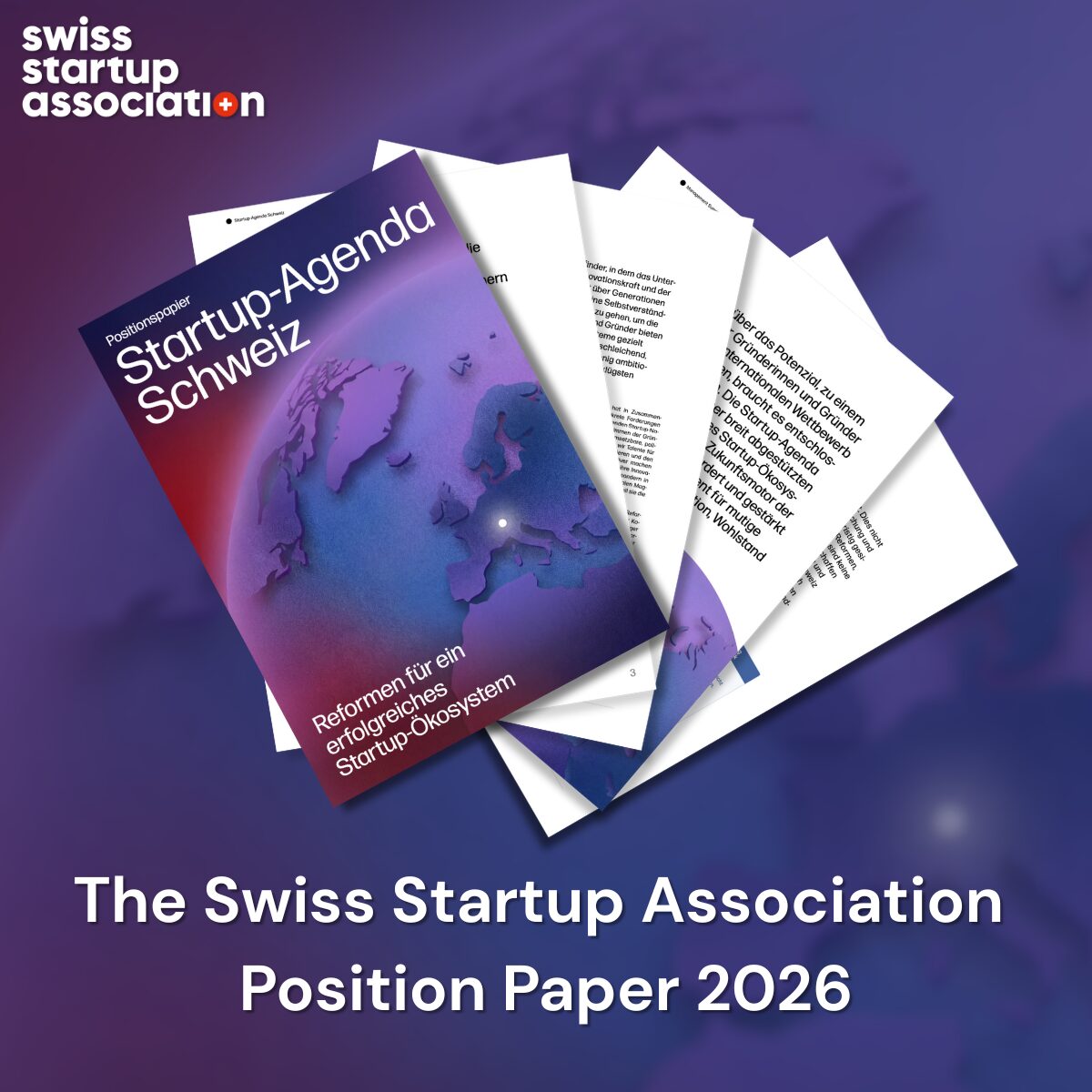 Read more: 20 Reforms to Compete Globally: The Swiss Startup Agenda by SSA
Switzerland’s startup ecosystem has reached a critical inflection point. While the country continues to lead Europe in per-capita spinout creation and deep tech innovation, structural…
-
 Read more: A Surprising Record Sparks Optimism
On 3 February, the Venture Capital Report was published, analysing investments in Swiss start-ups in 2025. Despite growth of 24 per cent, the total capital…
-
Read more: Switzerland: A Leading Global Scale-up Hub
More money has flowed into all Swiss scale-ups per capita than into scale-ups in the US or Israel. This is backed by a ten-year growth…


Biotech
News
-
Windward Bio files for IPO at Nasdaq
Basel-based Windward Bio, a clinical-stage biotechnology company focussing on immunological diseases has applied to list its common shares on the Nasdaq Global Market. Since launching…
startupticker.ch
-
Nouscom raises $135 Million to advance its cancer immunotherapy
Basel-based Nouscom closed an oversubscribed $135 million Series D financing. Proceeds will fund advancement of Nouscom’s lead asset NOUS-209, an investigational, off-the-shelf neoantigen-based cancer immunotherapy…
startupticker.ch
-
Alentis and CSL enter USD 1.6 billion partnership
CSL and Alentis announce global partnership to develop and commercialise lixudebart for rare kidney and liver diseases. Alentis will receive USD 355 million initial payment…
startupticker.ch
-
NovaGo Secures USD 30 Million to Advance Proof-of-Concept Study in Acute Spinal Cord Injury
NovaGo Therapeutics AG, a clinical-stage biotechnology company, develops anti-Nogo-A biologics with the goal of delivering the first regenerative treatment for patients with acute spinal cord…
startupticker.ch
-
Boehringer Ingelheim acquires equine health startup Evax
Boehringer Ingelheim has acquired Evax AG, a Swiss biotech company focused on therapeutic vaccines to address significant unmet needs in horses, particularly for the treatment of allergic…
startupticker.ch
-
Vaderis Therapeutics closes USD 152 million Series B Financing
Basel-based Vaderis Therapeutics, a clinical-stage biopharmaceutical company focused on developing targeted therapies for rare vascular diseases, today announced the closing of a private $152 million…
startupticker.ch
FAQ on Swiss Enterprise Software
1. Why is Switzerland a global powerhouse for BioTech investment?
Switzerland is a “global hotspot for biotech innovation” and a “powerhouse in European innovation”. It combines a high concentration of pharma expertise in Basel, academic excellence, and a “proven playbook” for moving discoveries from the lab to high-value exits
2. What is the “BioTech playbook” for Swiss startups?
It refers to the well-established path for Swiss BioTechs: spinning out of world-class academic labs, raising capital from experienced local and international VCs
, and progressing toward a high-value exit (M&A or IPO), a path proven by numerous successful companies.
3. What is the role of Basel in the global BioTech industry?
Basel is one of the world’s most important life science hubs, often called the “pharma capital.”. It is home to the global headquarters of Roche and Novartis, creating an “exceptional concentration of pharma expertise” that fuels the entire startup ecosystem.
4. How much venture capital has been invested in Swiss BioTech?
Swiss BioTech startups have raised $4.8 billion since 2019. 2024 was the most active year ever for BioTech funding. This sector alone has generated over $63.7 billion in enterprise value.


