Focus Sectors | Verticals
Robotics
Why Switzerland for Robotics
Switzerland is at the epicenter of the global robotics revolution, translating complex research in autonomous systems, hardware, and embodied intelligence into high-value industrial applications. The nation’s ecosystem is not just a research hub; it is a world-leading producer of robotics startups. This innovation emerges primarily from the ETH-EPFL corridor, which is widely recognized as the leading robotics cluster in Europe. This concentration of talent from institutions like ETH Zurich and EPFL, academic excellence, and capital convergence is creating a new generation of industrial automation.
For international investors, the Swiss robotics sector represents a unique opportunity. The ecosystem is defined by a pragmatic, customer-driven approach, where startups collaborate closely with industrial partners to build solutions that are reliable, effective, and market-ready. This pragmatic mindset, combined with deep science, de-risks investment and accelerates the path to commercialization for technologies in inspection, logistics, manufacturing, and beyond.
This page provides a comprehensive overview of the Swiss robotics landscape. Here, you can explore the key statistics driving the sector, discover the top-funded companies and rising stars emerging from our leading hubs, and gain insights from the industry leaders who are scaling Swiss robotics innovation to the world
Notable Companies





Key Stats*
55+
VC-Backed startups
$606M
VC funding since 2019
$2.0B
Combined Enterprise Value
Tob Hubs in Zurich (ETH) and Lausanne (EPFL).
* All data is taken from the Swiss Deep Tech Report 2025.
Companies to watch
Autonomous security robots for property surveillance.
Advanced robotic arms and actuators.
Intelligent and adaptable robotic systems.
AI-powered platform for industrial automation.
Autonomous advanced robotic excavators.
Scalable AI models for universal robotic manipulation.
AI-driven software enabling plug-and-play robots.
Robotic digital manufacturing (RDM) cells.
Compact underwater drone for inspections.
«Robots are rapidly expanding beyond factory floors, propelled by breakthroughs in Al and embodied intelligence. With learning-based mobility and manipulation, combined with LLM-powered common-sense reasoning, quadrupeds and humanoids are poised to transform industries ranging from logistics to inspection and construction. While the U.S. and China have traditionally led the charge, Europe is gaining momentum. At the center of this movement is Switzerland, where Deep Tech talent, academic excellence, and capital converge, positioning the country as a key player in one of this century’s most transformative industrial revolutions.»

Prof. Marco Hutter
Director Robotic Systems Lab
ETH Zürich
«Switzerland launches the most robotics startups per capita, yet the opportunity still feels under-priced given the depth of the science base and concentration of both engineering talent and customers. At IQC, we have spent 20 years deploying capital into Deep Tech in Europe. Over this time many ecosystem clusters have formed around technologies. The ETH-EPFL corridor is unquestionably the leading robotics cluster in Europe. In the last 18 months we have backed two of the nine companies listed and the standout common feature we have observed in Swiss robotics founders is a pragmatic, customer driven approach – automation simply needs to work, reliably and cheaply.»

Archie Muirhead
Partner
IQ Capital
Who’s Who in Robotics
-

>>venture>>
Zurich
>>venture>> is Switzlerland’s leading early-stage startup competition. Established in 1997, it is co-organized by ETH Zurich, McKinsey & Company, Knecht Holding, Innosuisse, and EPFL. Every year, the competition supports innovative startups by providing them with over CHF 590,000 in non-dilutive funding, mentorship and access to an vast network of industry experts.
-
-

be-advanced AG
Bern
We guide entrepreneurs to success! with high end Coaching, Workshops and Business Connections
-

Bluelion Foundation
Zurich
We are a leading Tech Startup Hub & community in Zurich, supporting founders with everything they need to grow successful tech startups.
-

DAA Ventures
Geneva
We are a Venture Capital firm investing in deeptech startups in Switzerland and Europe
-
Drone Industry Association Switzerland
Geneva
Switzerland’s leading drone association, recognized as the primary hub connecting industry stakeholders, associations, regulators, and the general public.
-

ESA BIC Switzerland
Zurich
ESA BIC Switzerland, an incubator, supports Swiss start-ups using space technologies. It offers tech & business support, up to EUR 200K non-dilutive funding, a large network.
-

ETH Entrepreneurship
Zurich
ETH Entrepreneurship supports, encourages & challenges entrepreneurs & start-ups. It is the leading organization for the ETH Pioneer Fellowship & UPortunity ETH accelerator.
-

Founderful
Zurich
Founderful is Switzerland’s leading pre-seed fund. First, fast & founder-friendly, backing Switzerland’s best tech entrepreneurs to become global market leaders.
-
Gebert Rüf Stiftung
Zurich
Foundation’s CHF 15M annual budget helps tech breakthroughs & builds entrepreneurial attitude/innovation interest via education & transfer projects.
-

Greater Geneva Bern area (GGBa)
Lausanne
Greater Geneva Bern area (GGBa) is the official investment promotion agency for Western Switzerland.
-

Greater Zurich Area
Greater Zurich Area
Greater Zurich Area Ltd. (GZA) is the official investment promotion agency of the economic region of Zurich, Switzerland. GZA helps international companies expand into Switzerland by providing free, tailor-made support – from evaluating locations and navigating taxes and regulations to connecting with key partners in business, academia, and government.


Most Active Swiss VCs in Robotics









Data-based insights research

The ETH-EPFL Spinoff Pipeline as Structural Advantage
The Swiss Deep Tech Report 2025 counts 55 or more VC-backed robotics startups in Switzerland with a combined USD 606 million raised since 2019 and a total enterprise value of USD 2 billion. What distinguishes this output is less its volume than its origin: Swiss robotics companies are disproportionately founded by researchers who spent five to ten years developing the underlying science before commercializing it, a pattern that reflects the culture of ETH Zurich and EPFL, where robotics groups are funded for fundamental contributions to locomotion, perception, control, and optimization rather than for short-horizon product development. The result is a cohort of companies that enter the market with deeply validated IP rather than working prototypes — ANYbotics, Embotech, and Sevensense were each founded by researchers who had published extensively on their core technology before raising a first round.
This has practical consequences for how Swiss robotics ventures are capitalized and how they grow. Because core technology is typically mature before the company is formed, early-stage capital is applied to productization and customer development rather than basic R&D, compressing time to first revenue. The hardware-first character of Swiss robotics also pre-selects for founders comfortable with the safety certification requirements — TÜV, CE, IEC 61508 — that industrial buyers impose before deployment in live facilities. These requirements function as a barrier that eliminates less serious entrants, but Swiss founders, coming from research environments where safety and reproducibility are non-negotiable, are structurally better prepared to navigate them than counterparts from software-first ecosystems.
Industrial Switzerland as a Built-In Customer
Switzerland’s domestic industrial base — precision manufacturing, chemicals, logistics, pharmaceutical production, food processing — provides Swiss robotics startups with a concentrated set of technically demanding early customers prepared to co-develop rather than wait for off-the-shelf solutions. Industrial buyers in Switzerland tend to have their own engineering teams, a high tolerance for novel technology when it is de-risked through rigorous validation, and the global facility footprints that turn a successful pilot into a multi-site rollout contract. A startup that achieves certified deployment in a Swiss pharmaceutical cleanroom or automotive plant has, in effect, passed a qualification process that transfers directly to equivalent facilities in Germany, the US, and Japan.
The co-development model shapes product-market fit in ways that purely capital-driven development cannot replicate. Swiss industrial customers push for reliability, safety documentation, and integration with existing OT stacks — not features or demos — and this pressure is visible in how the sector’s funding rounds are structured. ANYbotics closed a Series B extension in December 2024 led by Qualcomm Ventures that brought total funding past USD 150 million, with Climate Investment — a fund whose LPs include Aramco, BP, Equinor, and Shell — participating alongside existing financial investors; its largest customers had become equity holders. Embotech’s CHF 23.5 million Series B in December 2024 was led by Emerald Technology Ventures and BMW i Ventures alongside a contracted multi-year deployment of its Automated Vehicle Marshalling system across six BMW passenger car factories, and a separate rollout of 30 autonomous electric tractors at the Port of Rotterdam — the customer relationship and the investment thesis were structurally the same. Ecorobotix raised USD 150 million across its Series C (USD 45 million, 2024) and Series D (USD 105 million, 2025) with BASF Venture Capital and Yara Growth Ventures — two of the largest incumbents in the agrochemical market — on its cap table, now operating in more than 20 countries across Europe, the Americas, and Oceania.
The Corporate Integration Channel
Switzerland hosts a cluster of large industrial corporations — ABB, Georg Fischer, Bühler, and Sulzer among them — that maintain active R&D operations domestically and have established formal mechanisms for identifying and absorbing spinoff technology from ETH and EPFL. According to the TOP 100 Swiss Startup Award 2025, major corporates have already acquired eight Swiss robotics startups that have featured in the TOP 100 ranking — a rate of strategic absorption that has no equivalent in comparable European tech clusters. ABB’s approach is the most systematic: the Zurich-headquartered automation group runs an internal innovation challenge specifically designed to surface university spinoffs relevant to its robotics portfolio, which progresses from challenge winner to minority investment to full acquisition — with the engineering team retained in Zurich as a global product center. The acquisition of ETH spinoff Sevensense in January 2024 is the most recent execution of this playbook: founded in 2018, Sevensense received a minority investment from ABB Technology Ventures in 2021 following its innovation challenge win, and was fully acquired three years later with its 35-person Zurich team retained and its Visual SLAM technology now integrated into Ford and Michelin factory deployments worldwide.
The practical effect is a built-in exit channel that does not depend on US strategic acquirers or public markets, and that tends to preserve the geographic concentration of talent and institutional knowledge in Zurich and Lausanne. That concentration is being reinforced at the research layer: in September 2025, ETH Zurich and MIT jointly opened the Robotics and AI Institute (RAI) in Zurich, led by Prof. Marco Hutter, linking two global centers of excellence and deepening the pipeline of talent and IP feeding directly into the startup ecosystem. For investors, this makes the exit distribution more predictable than in ecosystems where the only realistic outcome is a transatlantic acquisition that relocates the team. For the ecosystem as a whole, it means acquired technology and the engineers behind it continue generating spillovers — publications, further spinoffs, talent networks — within Switzerland rather than being absorbed into a remote product organization, and that the next generation of companies entering the corporate integration channel is being shaped by institutional infrastructure that is actively expanding.
Success Stories
-
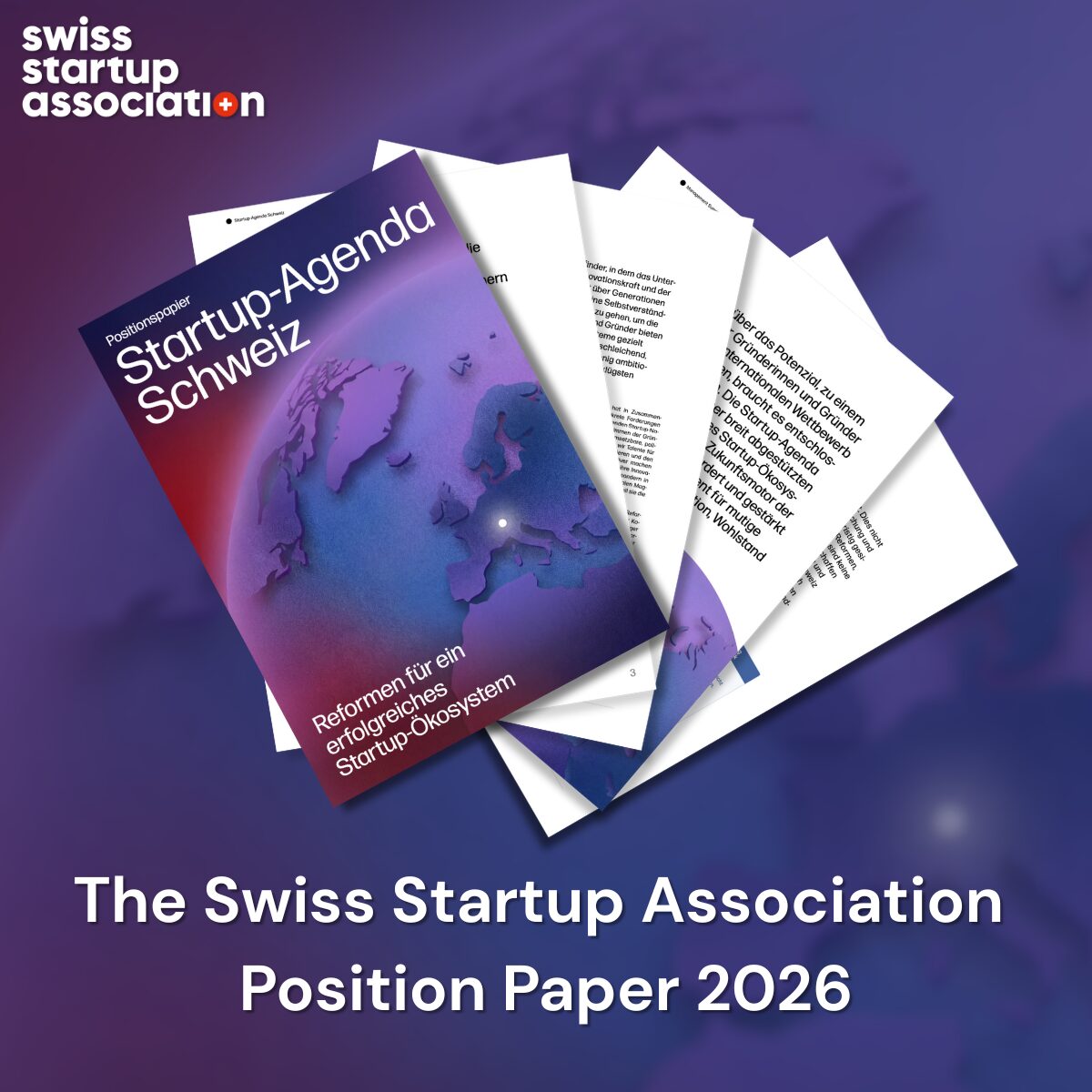 Read more: 20 Reforms to Compete Globally: The Swiss Startup Agenda by SSA
Switzerland’s startup ecosystem has reached a critical inflection point. While the country continues to lead Europe in per-capita spinout creation and deep tech innovation, structural…
-
 Read more: A Surprising Record Sparks Optimism
On 3 February, the Venture Capital Report was published, analysing investments in Swiss start-ups in 2025. Despite growth of 24 per cent, the total capital…
-
Read more: Switzerland: A Leading Global Scale-up Hub
More money has flowed into all Swiss scale-ups per capita than into scale-ups in the US or Israel. This is backed by a ten-year growth…


Robotics
News
-
Gravis Robotics completes $23M round to accelerate international expansion
ETH spinoff Gravis Robotics, the startup enabling next-generation earthmoving autonomy that boosts job site performance, has finalised a $23 million funding round co-led by IQ…
startupticker.ch
-
Switzerland leads the way in spin-offs
Swiss universities and the Swiss innovation system as a whole consistently perform very well in rankings, while the start-up ecosystem usually revealed some weaknesses. The…
startupticker.ch
-
$150 million to scale DEXTER the surgical robot across the US
Distalmotion, the developer of surgical robot DEXTER which is designed to empower access to the benefits of robotic surgery in outpatient sites of care, has…
startupticker.ch
-
Mimic Robotics banks $16 million seed funding
Zurich-based robotics startup mimic has closed an oversubscribed $16 million funding round led by Elaia, alongside Speedinvest. The investment will be used to accelerate the…
startupticker.ch
-
ETH-Spin-off secures €3.5 million to advance its under water robot
Tethys Robotics has raised €3.5 million in a pre-seed financing round led by Redstone, to further develop and scale up its autonomous underwater drone, the…
startupticker.ch
-
Ecorobotix secures USD 150 million to accelerate growth
Ecorobotix is the global leader in AI-powered Ultra-High Precision (UHP) spraying. Building on rapid growth, proven field results, and a strong financial foundation with $150…
startupticker.ch
FAQ on Swiss Robotics
1. Why is Switzerland a top location for robotics investment?
Switzerland combines world-leading research from institutes like ETH Zurich and EPFL with a “pragmatic, customer-driven approach” and a high concentration of engineering talent. This “ETH-EPFL corridor” is considered the leading robotics cluster in Europe.
2. What is the ETH-EPFL robotics cluster?
It refers to the globally significant concentration of robotics labs, startups, talent, and industrial partners located in and around the two Swiss Federal Institutes of Technology in Zurich (ETH) and Lausanne (EPFL).
3. Which are the top robotics companies in Switzerland?
he ecosystem includes major successes and future unicorns like ANYbotics and Ecorobotix, as well as a deep pipeline of rising stars such as RIVR, mimic, and Ascento
4. What are the key investment opportunities in Swiss robotics?
Opportunities span industrial automation, elderly care, inspection, logistics, autonomous systems, surgical robotics, and robotic manipulation driven by AI.
5. How does Switzerland’s robotics innovation compare to the rest of Europe?
Switzerland is the recognized leader in Europe for robotics. It launches the most robotics startups per capita, backed by a deep science base and a strong concentration of both engineering talent and industrial customers
6. What support does the Swiss ecosystem offer for scaling a robotics company?
The ecosystem provides a dense network of suppliers, close collaboration with research labs for talent, and a customer base of “tech-forward” industrial leaders who act as design partners, helping to de-risk and validate new technologies.


